Cashilor guide book
This is the long version. Read it once and you will know what every page is for, how the bots find a trade, how to check our work, and what you actually need to do first. Nothing here assumes you have traded before.
Cashilor is a trading terminal and a trading school in the same place. The terminal side gives you the data: prices, charts, news, on chain flows, analysis of any coin or stock you type in. The school side explains what that data means and shows you real trades being taken, won and lost, so you can watch a method work over time instead of taking somebody's word for it.
The reason the two sit together is simple. Data with no method just makes you anxious. A method with no data makes you guess. You need both, and you need to see the losses as well as the wins before you trust either one.
Everything you can read is free and stays free. You never pay to look at the terminal, the education or the full record of every bot. The paid memberships exist for the live services: the private community, having the bots place trades on your own exchange account, and access to the founder's own trades. More on that further down.
When you signed up you were given a permanent id that looks like CSH-4K7QW2. It is yours for life and it is how every part of the platform knows you: your watchlist, your dashboard, your membership if you ever take one, and your place in the community.
You can see it any time by opening the account menu at the top right of the site. Keep it somewhere. If you ever write in about your account, that id answers most questions in one line.
There are a lot of pages. You do not need all of them. Here is what each one is for, in the order they appear in the menu.
The front page. Type any coin, stock, gold or currency pair and you get a full read on it: trend, momentum, where the important price levels sit, what the order book looks like, what the news flow is doing and a plain summary at the end. This is the page to open when somebody mentions a ticker and you want to know whether it is worth your attention.
The wide view. What is moving today, what is leading, what is bleeding, how much fear or greed is in the market. Use it in the morning to decide where to look, not what to buy.
The lessons. Start at the beginning even if you think you know it. The order is deliberate: how a market actually works, then how to read a chart, then risk, then the patterns the bots use. Risk comes before patterns on purpose.
Every automated strategy on the platform, what each one looks for, and what it is doing right now. Each bot has its own page with its open trades and its full history, and each one is marked as either in testing or deployable.
Trading costs money in fees. If you open an exchange account through the links here, part of the fee you pay comes back to you. It is not a trick and it does not cost you anything extra; exchanges share fee revenue with anyone who sends them customers, and this page passes that share back to you.
The scoreboard. Every closed trade from every bot, wins and losses together, with the numbers recalculated from the raw trade log each time you load it. This is the page to be sceptical on. It is meant to be checked.
Market news pulled together and sorted by what actually moves price, rather than what gets clicks.
Your own page. Covered in its own section below.
Astro looks at market timing through planetary cycles, which you are free to ignore completely. Gems hunts small tokens early. Tools holds the calculators, including the position size calculator you should be using. Arcade is a practice account with a hundred thousand fake dollars so you can make your first mistakes for free. Analysts is a marketplace of independent callers with their records attached. IPO, Events, Watchlist and Wallet do what their names say.
A bot here is a set of rules that watches the market all day and speaks up when a very specific situation appears. It is not a prediction machine and it is not magic. It is patience written down, running without getting tired or bored or emotional, which is the only real advantage it has over a person.
Every signal a bot produces has four parts, and if any of them is missing it is not a trade, it is an opinion:
Entry is the price where the idea becomes valid. Stop is the price where the idea is proven wrong and you leave. Target is where the idea has paid and you take it. Size is how much you put in, worked out from the distance between your entry and your stop. Size is the part beginners skip and it is the part that decides whether you survive.
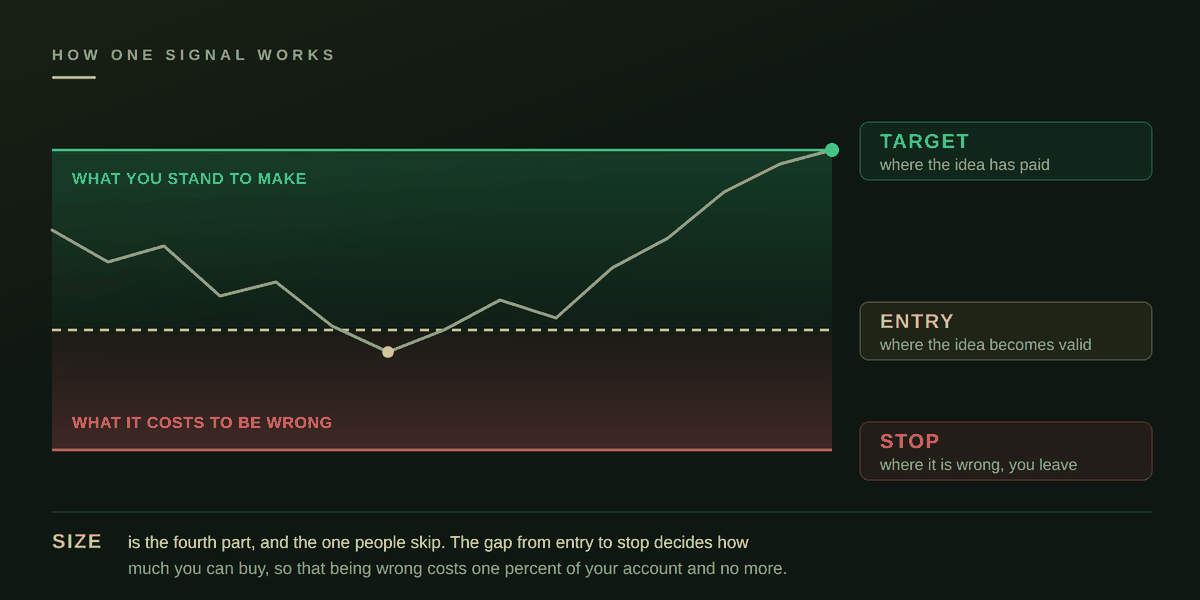
Every signal on Cashilor carries all four, published before the trade is taken rather than explained after it.
Every bot starts in testing. While it is there it posts its signals in the open and its results are recorded exactly like any other, but nobody can put it on a real account. It stays in testing until it has enough closed trades for the numbers to mean something, and until those numbers hold up. Only then does it move onto the deployable list, where members can switch it on. New bots are added over time and one that stops working can be moved back, so treat the list below as what is running today rather than a fixed set.
These are the bots running at the moment and what each one waits for.
Waits for a market to go quiet. When price stops moving and the range tightens up, pressure builds, and the move that follows tends to be fast. The bot measures how tight the range has become and speaks when it is tighter than it has been in a long while, then takes the direction price breaks in. Available to VIP members.
Not a bot in the usual sense. This is the founder's own trading, pushed live the moment a position is taken, with the entry, the stop and the target shown. VVIP members can have these executed on their own account, sized to their capital. Available to VVIP members.
Looks for price falling into a level that has held several times before, and waits for the first sign that buyers are defending it again rather than guessing that they will.
Big players need other people's orders to fill their own. Those orders sit just under obvious lows and just above obvious highs. This bot watches for price dipping through one of those clusters and snapping straight back, which usually means the orders have been taken and the real move is the other way.
When price breaks out of a range, the honest breakouts usually come back to touch the level they broke before continuing. The bot ignores the break itself and waits for that touch, which costs a little upside and avoids a lot of false starts.
Takes the idea further. A level that was resistance for weeks and then breaks often becomes support. The bot tracks levels that have changed sides and trades the first reaction to the new role.
In a trend that is already running, the bot measures the whole move and waits for price to come back into what we call the Vertex zone, the part of the pullback where trends most often resume. It does not chase the initial move.
Ranges have edges, and price pokes out of them constantly without meaning it. The bot waits for a push outside the range that fails and closes back inside, then trades back toward the other edge.
Notice that most of them are waiting for the same thing in different clothes: a move that looks convincing, fails, and traps the people who believed it. That is not a coincidence. Most reliable trades are somebody else being wrong in public.
Anyone can show you winners. The only number that tells you anything is the whole set, and that is what the Record page holds. Here is how to read it without fooling yourself.
A bot that wins seven times out of ten and loses more on each loss than it makes on each win is losing you money. A bot that wins three times out of ten with big winners is making it. Always read win rate next to the net result, never alone.
Ten closed trades tells you almost nothing. A hundred starts to mean something. If a bot on the record has a short history, treat its numbers as a rough hint and nothing more.
Some signals never reach their entry price. They are marked cancelled and kept out of the win and loss count, because nothing was ever risked. They are still shown, so you can see how many ideas did not turn into trades.
Every bot's full history can be downloaded as a spreadsheet from its page. Open it, add up the column yourself, and see whether the headline matches. We would rather you did that than believed us.
The dashboard is your own page, and it fills up as you use the platform. It shows the capital you have told it about, every trade taken on your account with the result, your return over time as a line rather than a single number, which bots contributed what, and what is open right now.
It matters more than it sounds. Most people who lose money at this never actually look at their own numbers; they remember the trades that felt dramatic and forget the rest. A dashboard you check weekly turns trading from a feeling into a set of facts, and facts are the only thing you can improve.
It works on the free plan for anything you log yourself. It fills in automatically once the bots are deploying to your exchange account on a paid plan.
The entire terminal, all the analysis, all the education, every bot's public record including the losses, the practice account with a hundred thousand demo dollars, your watchlist and your permanent Cashilor id. No card, no expiry. This is a real plan, not a trial.
Everything in Free, plus the private community where every signal is explained while it is happening, plus auto deploy, which means the bots place their trades on your own exchange account instead of you watching and copying. You also see the live open trades of the deployable bots and get your permanent VIP id.
Everything in VIP, plus the Manual Trade BOT: the founder's own trades executed on your account, sized to your capital with the risk you choose, and a live view of every one of those trades with its entry, stop and target. VVIP also includes a live session with the founder every fortnight, where the last two weeks get pulled apart trade by trade, the losses included, and you can ask anything.
Both memberships run for thirty days at a time and are paid in crypto. Renewals add on top of the days you have left, so paying early never costs you anything. Current prices are on the pricing page, which is the honest place to check them because they move with the launch offer.
Auto deploy is the part that makes a membership worth more than a signal group. You connect your own exchange account once, and from then on the bots you have switched on place their trades there, with the stop and the target already attached, at the size your risk setting works out.
Read this part slowly, because it is the part people are right to be careful about. Your money stays in your own exchange account the entire time. You create the API keys yourself inside your exchange, and you create them with trading permission only and withdrawal permission switched off. Cashilor never holds your funds and, with the keys set up that way, could not move them anywhere even if it wanted to. You can revoke the keys from your exchange at any moment and everything stops immediately.
Start it small. The first month is for watching it behave, not for maximising anything.
There are rooms on Telegram and on Discord, and they carry the same thing. Free members get the general rooms: market chat, news, the live price board and the running performance table for every bot. VIP members also get the room where the Squeeze BOT posts and where signals get explained as they happen. VVIP members additionally get the room carrying the founder's manual trades.
On Discord you do not have to type anything to get in. Open the VIP page while signed in, press Connect Discord, and the right rooms open up by themselves. If your membership lapses the paid rooms close again and reopen when you renew.
If you read nothing else here, read this. Almost nobody who blows up an account does it because they picked bad trades. They do it because they picked the right size for the trade they hoped for instead of the trade they might get.
Decide, before you enter, the most you are willing to lose on this single trade. Make it one percent of your account, or two at the very most. Then work backwards: the distance from your entry to your stop tells you how big the position can be so that being wrong costs you exactly that much and no more. The calculator under Tools does the arithmetic.
Worked through
| Your account | $5,000 |
| Most you will lose on this one trade, 1% | $50 |
| Your entry | $186.40 |
| Your stop, 4% below | $178.94 |
| So the position can only be | $1,250 |
Put in more than that and the stop stops protecting you. The calculator under Tools does this for you, and auto deploy does it on every trade without being asked.
Sized that way, ten losses in a row is a bad month and not a disaster, and ten losses in a row will happen to you eventually. Sized the other way, three bad days can end it.
Two more that cost people real money. Do not move a stop further away because price is approaching it; that is the moment you were supposed to be protected from. And do not add to a position that is losing in the hope of a better average price, because you are increasing your risk precisely when the market is telling you that you were wrong.
Open the Record page and look at the losses before the wins. Get a feel for how often this goes wrong, because it will, and you want to have seen it on a screen before you see it in your own account.
Do the first three lessons under Learn. The risk one is the one that matters.
Open the Arcade and take five trades with the demo money. Write your entry, your stop and your target down before each one. Five, not fifty.
Follow one bot and one bot only. Watch every signal it gives without trading any of them. You are not looking for winners, you are checking whether the way it behaves is something you could live with.
If you decide to put real money in, start with an amount that would annoy you to lose and not one that would hurt. Everything after that is patience.
Entry the price at which a trade idea becomes valid.
Stop the price at which the idea is wrong and you leave.
Target the price at which the idea has paid.
Long betting price goes up. Short betting it goes down.
Support a price where buyers have shown up before.
Resistance a price where sellers have shown up before.
Range price moving sideways between a floor and a ceiling.
Breakout price leaving that range.
Retest price coming back to touch the level it just broke.
Liquidity resting orders, which is what large players need to fill.
Sweep price running through those orders and reversing.
Pullback a pause against the direction of a trend.
Vertex zone the part of a pullback where trends most often resume.
Drawdown how far your account has fallen from its high point.
Risk per trade the money you accept losing if the stop is hit.
No. Start free, do the lessons, use the practice account. The platform is built so that the reading costs you nothing and the mistakes cost you nothing either, until you decide otherwise.
No, and nobody honest can. Bots lose trades every week and it is all published. What we can promise is that the record you are shown is the whole record.
Never. It sits in your own exchange account under keys you create and can revoke.
The paid rooms close, auto deploy pauses, and nothing else changes. Your account, your id, your history and the whole free terminal stay exactly as they were. Come back whenever.
No. Cashilor is an educational platform and a set of research tools. Everything here is information to help you make your own decisions. Trading carries real risk and you can lose what you put in.
Open the terminal, follow one bot, and check the record when you feel like doubting us. That is the right order.
Cashilor is an educational platform. Nothing on this page is investment advice or a recommendation to buy or sell anything. Markets are risky and you can lose your entire investment.